
Vesicles loaded with NMN can more effectively delay skin aging.
Classification: Industry News
Publication:2026-01-20 12:50
Recently, a study published in the journal Stem Cell Research & Therapy demonstrated that small extracellular vesicles (sEVs) derived from human umbilical cord cells loaded with NMN can counteract wrinkles and skin thinning—both hallmark signs of aging—in a mouse model of cutaneous aging. Moreover, NMN‑loaded sEVs reduced levels of senescence‑associated protein biomarkers and protected against DNA damage in the aged skin model. These findings suggest that encapsulating NMN within sEVs may represent an effective strategy to enhance NMN’s anti‑aging effects.
As we age, all of the body’s organs experience functional decline, with skin aging being particularly pronounced—largely because the skin is located on the body’s surface. As the body’s primary external organ, the skin maintains continuous interactions with its surroundings while also serving as a barrier against dehydration, ultraviolet radiation, and pathogens. Moreover, both internal and external factors contribute to skin aging, leading to a loss of structural integrity and a general reduction in skin function.
As we age, functionally impaired cells that secrete inflammatory molecules—known as senescent cells—accumulate in skin tissue. Consequently, these aging skin cells can release inflammatory signals into other tissues and organs, accelerating systemic aging. For instance, studies have shown that the presence of senescent cells in the skin promotes their accumulation in extracutaneous tissues, increasing the risk of frailty, impaired skeletal muscle function, and cognitive decline. In summary, given that skin aging may drive systemic aging via senescent cells, identifying strategies to slow skin aging could be key to combating overall aging.
In recent years, stem cell therapy has garnered significant attention in the field of tissue regeneration. In this context, umbilical cord‑derived stem cell vesicles have demonstrated some potential in protecting rat skin from ultraviolet‑induced damage. However, their ability to delay skin aging remains limited.
Similarly, the NAD+ precursor NMN has been shown in preclinical models to ameliorate a variety of age‑related conditions. Some evidence also suggests that NMN exerts anti‑aging effects. However, NMN is considered unstable in the bloodstream, which may limit its efficacy when administered orally or by injection. Therefore, developing strategies to stabilize NMN using sEVs could help determine whether this combination therapy more effectively delays skin aging than either approach used alone.
To unlock the potential of sEVs and combine them with NMN, the research team loaded NMN into sEVs. By leveraging the synergistic effects of these vesicles and NMN, they aim to slow skin aging while stabilizing circulating NMN levels, thereby enhancing its efficacy.
Umbilical vesicles containing NMN can delay skin aging.
To investigate the effects of NMN‑loaded sEVs on skin aging, the research team first established a mouse model of skin aging. To this end, the researchers applied D‑galactose, a monosaccharide, to the shaved backs of the mice. D‑galactose induces skin aging primarily by increasing oxidative stress—caused by elevated levels of harmful reactive oxygen species within cells—and by promoting the accumulation of advanced glycation end products, molecules associated with aging that arise from the reaction of sugars with proteins or lipids.
To deliver NMN‑loaded sEVs, sEVs alone, or NMN alone to the skin, the research team employed nano‑microneedle technology. Nano‑microneedles use tiny conical structures to create microchannels on the skin’s surface and facilitate drug delivery into the dermis. In this study, the team used nano‑microneedles to deliver NMN‑loaded sEVs, sEVs alone, or NMN to deeper layers of the skin than those reached by topical formulations such as creams.
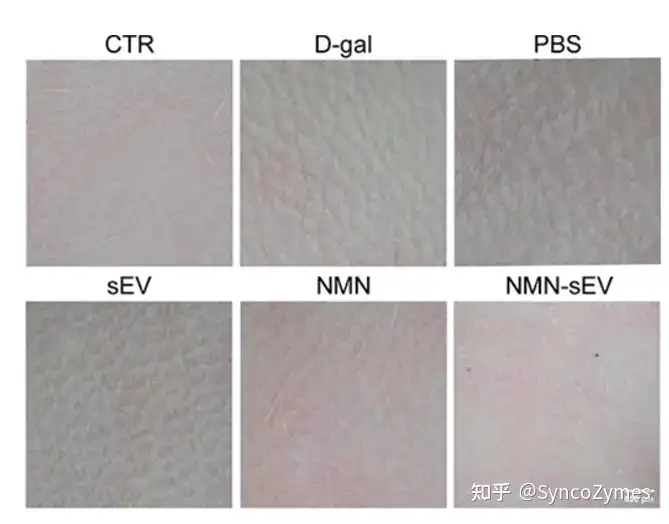
The research team used nano‑microneedles as delivery vehicles, treating skin‑aging model mice with sEVs loaded with NMN, with NMN alone, or with sEVs alone, to evaluate the efficacy of each approach in delaying skin aging. As expected, the dorsal skin of untreated aging model mice exhibited fine wrinkles. In contrast, mice treated with either sEVs or NMN showed a marked reduction in wrinkles following depilation. Interestingly, mice receiving sEVs loaded with NMN displayed virtually no wrinkles, and their skin was indistinguishable from that of normal mice not subjected to D‑galactose‑induced skin aging. These findings indicate that sEVs loaded with NMN are more effective than sEVs or NMN alone in delaying skin aging.
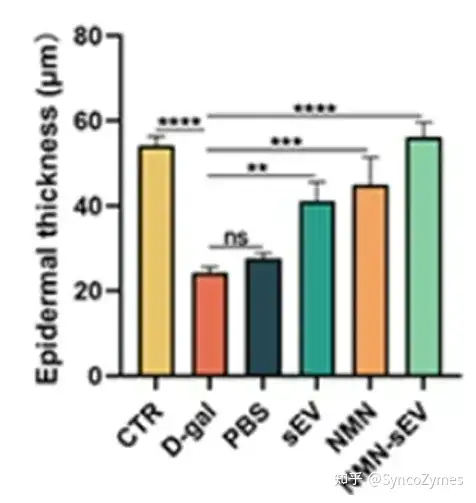
Because skin thinning is closely linked to aging, the research team sought to assess the effects of NMN‑loaded sEVs, sEVs alone, and NMN alone on skin thickness in a mouse model of skin aging. As expected, mice treated with D‑galactose applied to the shaved back to induce skin aging exhibited significant skin thinning. Moreover, skin thinning was attenuated in all treatment groups—sEVs, NMN, and NMN‑loaded sEVs—with the most pronounced improvement observed in the group receiving NMN‑loaded sEVs. These findings indicate that NMN‑loaded sEVs are more effective than either sEVs alone or NMN alone in delaying skin aging.
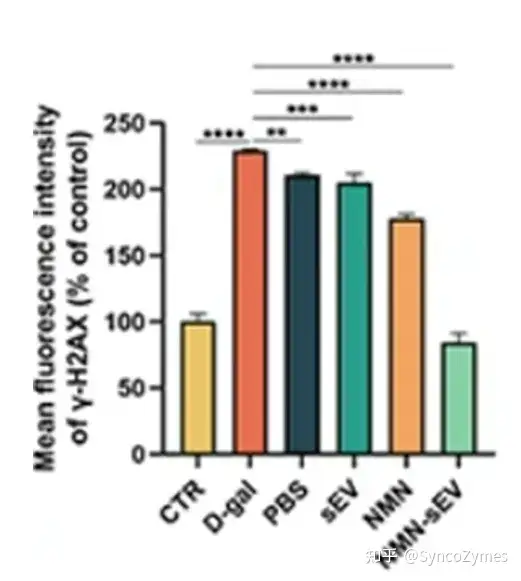
To confirm that NMN‑loaded sEVs can mitigate skin aging at the cellular level, the research team assessed cellular markers of senescence—senescence being a cell‑intrinsic state of dysfunction associated with aging. They also examined how NMN‑loaded sEVs influence cellular markers of DNA damage, given the close link between DNA damage and aging. Based on their evaluations of these biomarkers, D‑galactose‑induced skin aging indeed elevated both senescence‑related and DNA‑damage‑associated markers in skin cells. In contrast, treatment with NMN‑loaded sEVs, sEV treatment, and NMN treatment all attenuated senescence and DNA damage, with NMN‑loaded sEVs demonstrating the most pronounced effects. These findings indicate that, at the cellular level, NMN‑loaded sEVs—which integrate NMN delivery with the sEV platform—are more effective than either sEVs or NMN alone in alleviating hallmarks of aging, such as cellular senescence and DNA damage.
Vesicles containing NMN may help slow down the aging process throughout the body.
The findings of this study indicate that, in a mouse model of skin aging, sEVs loaded with NMN can synergistically enhance the anti‑aging effects observed when sEVs or NMN are used alone. However, since the research team employed D‑galactose–treated mouse skin to mimic skin aging—conditions that differ from naturally aged skin—future studies should investigate whether NMN‑loaded sEVs can similarly delay skin aging in aged mice. The team likely chose the D‑galactose–induced mouse skin aging model because laboratory mice typically live for about two to three years; thus, this approach requires less time, labor, and funding.
With respect to human applications, clinical trials are still needed to determine whether sEVs loaded with NMN exert similar anti‑aging effects on human skin. Furthermore, since loading NMN into sEVs may help stabilize the compound, such trials could also assess whether NMN‑loaded sEVs can systemically delay aging in organs beyond the skin.
Based on this, ongoing research is investigating whether humans can derive potential therapeutic benefits from the oral intake of sEVs. If studies confirm that sEVs can indeed be administered orally in humans, loading NMN onto sEVs could represent a novel approach to synergistically enhance both sEV‑based therapies and NMN supplementation, thereby slowing systemic aging.
References:
Sun Z, Li J, Zheng Y, Zhang J, Bai W, Deng X, Wu Z, Xu X, Ding W, Qian H, Tan Y. Small extracellular vesicles derived from mesenchymal stromal cells loaded with β-nicotinamide mononucleotide activate NAD+/SIRT3 signaling pathway-mediated mitochondrial autophagy to delay skin aging. Stem Cell Res Ther. 2025 Jul 1;16(1):339. doi: 10.1186/s13287-025-04460-w. PMID: 40598314; PMCID: PMC12218950.
Leave a Message Online


Hotline: 021-68187180

Fax: 021-68187179

Email: services@syncozymes.com
Email:sales@syncozymes.com

Address: No. 1199, Landian Road, Zhoupu Town, Pudong New Area, Shanghai

 Shanghai Public Security Bureau Internet Information Service Security Filing No. 31011502015262
-
-