
Biocatalysis Series — Carboxylesterase
Classification: Industry News
Publication:2026-03-26 09:54
Introduction to Carboxylesterases
Carboxylesterases (Lipase & Esterase, PLE), also known as esterases or lipases, are a class of enzymes capable of catalyzing the cleavage and formation of carboxylic ester bonds. They participate in various reactions, including hydrolysis, esterification, and transesterification. The reaction equation for carboxylesterases is shown in Figure 1.
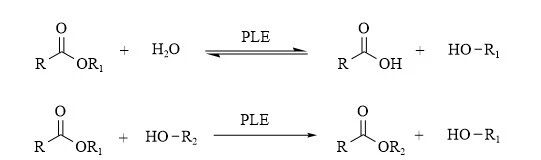
Figure 1. Reaction schemes for the catalytic hydrolysis, esterification, and transesterification reactions mediated by carboxylesterase.
Carboxylesterase is a type of esterase. Estearases are widely distributed in nature and exhibit great diversity. Based on their source, they can be classified as animal‑derived, plant‑derived, or microbial esterases, with the majority originating from microorganisms. According to the types of substrates they act upon, they can be further categorized into carboxylesterases (such as lipases and cholinesterases), mono‑phosphate esterases (such as alkaline phosphatase), di‑phosphate esterases (such as nucleases and phospholipases), tri‑phosphate esterases, thioesterases, and thiophosphate esterases, among others. [1-2] 。
All PLEs possess the canonical α/β hydrolase fold, which consists of a parallel β‑sheet composed of eight strands, with the second strand (β2) being antiparallel. The parallel β‑strands (β3–8) are linked by α‑helices (αA–F), which flank the central β‑sheet on either side (as shown in Figure 2). [3] The binding subdomains of α/β hydrolase‑fold proteins vary in both length and structure among different enzymes, which also accounts for the substrate diversity of esterases.
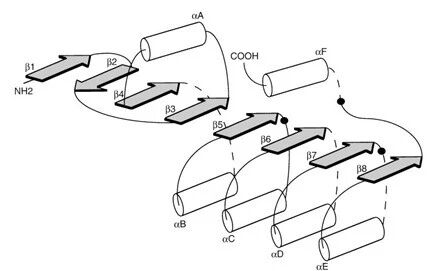
Figure 2. α/β hydrolase fold structure [3]
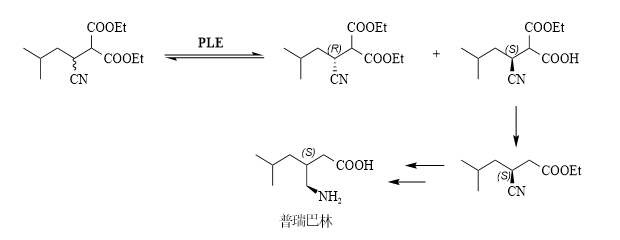
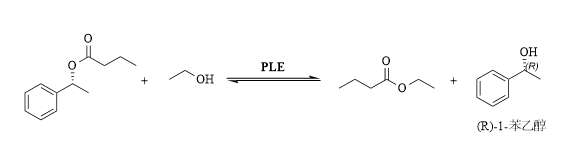
Due to the mild reaction conditions, broad substrate selectivity, ease of product isolation and purification, low formation of by‑products, reduced energy consumption, the absence of the need for cofactors, and its high stereoselectivity and specificity, carboxylesterase‑catalyzed reactions offer significant advantages. Consequently, carboxylesterases are now widely employed in fields such as food processing, novel biomaterials, chemical synthesis, biosensors, biomedicine, biodiesel production, and the synthesis of chiral pharmaceuticals. [1] . An example of the application of carboxylesterase in the synthesis of chiral pharmaceutical intermediates is as follows:
Example 1 , Preparation of Chiral Intermediates for Pregabalin [5]
Example 2 , Preparation (R)-1- Phenylethanol [6]
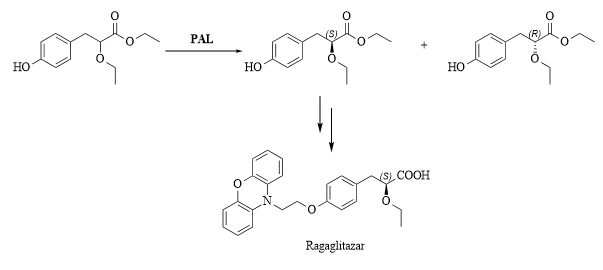
Example 3 , Preparation of Rogliza (Ragaglitazar) Intermediate [7]
Catalytic Mechanism of Ester Hydrolysis by Esterases
The catalytic mechanism of ester hydrolysis by esterases is based on a catalytic triad consisting of serine–histidine–aspartate/glutamate (Ser–His–Asp/Glu), which closely resembles that of serine hydrolases. The hydrolytic cleavage of carboxylic acid esters catalyzed by esterases proceeds in two steps (see Figure 3). In the first step, the acylation process occurs: the hydroxyl oxygen atom of the serine residue in the catalytic triad attacks the electrophilic carbonyl carbon of the lipid ester bond, generating an unstable tetrahedral intermediate that retains the negatively charged oxygen atom of the carbonyl group. This tetrahedral intermediate is stabilized through hydrogen bonding with the nitrogen‑containing scaffold (NH‑group) within the so‑called “oxyanion hole.” [4] ; His accepts the proton from the serine hydroxyl group, which is precisely transferred to the imidazole ring of histidine, partially neutralizing the resulting charge; subsequently, the proton is passed to the ester‑oxygen atom of a labile bond, leading to its cleavage. At this point, the acidic moiety of the substrate undergoes esterification with the nucleophilic serine, thereby releasing an alcohol. [3] . The second step is the deacylation process: the His residue at the active site abstracts a proton from a water molecule, thereby activating the water molecule to generate OH⁻. - ,OH - It attacks the carbonyl carbon of the acyl group covalently linked to Ser, a process that likewise generates a transient negatively charged tetrahedral intermediate, which is stabilized by interactions with the oxyanion hole. Histidine then donates a proton to the oxygen atom of the active serine residue, after which the serine residue releases the acyl product. Following release of the acyl product, the enzyme–fatty acyl complex returns to its original conformation, ready for the next catalytic cycle. [3] 。
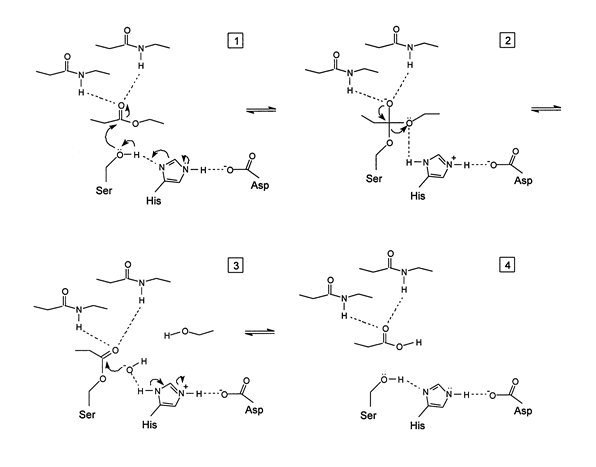
Figure 3. Catalytic mechanism of ester hydrolysis by esterases [3]
Introduction to the Enzyme Library and Enzyme Development Services
Since 2007, Shangke Bio has been dedicated to the research and development of bioenzymes, biocatalytic technologies, and synthetic biology techniques. Its existing esterase enzyme library (code-named ES-PLE) comprises 44 distinct esterases, enabling the company to offer customers enzyme screening, optimization of enzymatic reaction processes, enzyme engineering, and production‑supply services.
[1] Panda T, Gowrishankar BS. Production and applications of esterases. Appl Microbiol Biotechnol. 2005 Apr;67(2):160-9.
[2] Wang Yeqing. Screening, Expression, and Characterization of the Properties of Esterase and Lipase [D]. Jilin University, 2014.
[3] Jaeger KE, Dijkstra BW, Reetz MT. Bacterial biocatalysts: molecular biology, three-dimensional structures, and biotechnological applications of lipases. Annu Rev Microbiol. 1999;53:315-51.
[4] Shah H, Zhang C, Khan S, Patil PJ, Li W, Xu Y, Ali A, Liang E, Li X. Comprehensive Insights into Microbial Lipases: Unveiling Structural Dynamics, Catalytic Mechanism, and Versatile Applications. Curr Microbiol. 2024 Oct 7;81(11):394.
[5] Liu Jiayan. Study on the Substrate Profile and Molecular Engineering of p-Nitrobenzyl Esterase, and Its Application in the Synthesis of Chiral Aromatic Secondary Alcohols [D]. East China University of Science and Technology, 2014.
[6] Wang, W., Li, L., Wang, X., Qiu, T., Yang, J., & Ye, C. (2021). Reaction kinetic studies on the immobilized-lipase catalyzed enzymatic resolution of 1-phenylethanol transesterification with ethyl butyrate. Biocatalysis and Biotransformation, 39(1), 29–40.
[7] Deussen H-J, Zundel M, Valdois M, et al. Process development on the enantioselective enzymatic hydrolysis of S-ethyl 2-ethoxy-3-(4-hydroxyphenyl) propanoate. Org Process Res Dev, 2003, 7: 82-88.
Leave a Message Online


Hotline: 021-68187180

Fax: 021-68187179

Email: services@syncozymes.com
Email:sales@syncozymes.com

Address: No. 1199, Landian Road, Zhoupu Town, Pudong New Area, Shanghai

 Shanghai Public Security Bureau Internet Information Service Security Filing No. 31011502015262
-
-