
Cutting-Edge Research — Nutrients Publishes Findings: Spermidine Supplementation Can Delay Liver Aging
Classification: Industry News
Publication:2026-03-26 10:04
As people age, the liver accumulates scar tissue, leading to hepatic fibrosis. This physiological complication is accompanied by marked deterioration of the endothelial cell layer, which exacerbates liver damage and creates a vicious cycle. Previously, researchers have sought to counteract hepatic fibrosis by elevating levels of nicotinamide adenine dinucleotide (NAD). However, spermidine, a naturally occurring molecule found in all animal and plant tissues, has also emerged as a potential therapeutic agent for alleviating age‑related liver diseases.
Hernández and his colleagues at the University of Barcelona in Spain have… 《 Nutrients 》 Research published in the journal indicates that adding 3 mM spermidine to the drinking water of mice can protect hepatic endothelial cells from damage associated with liver fibrosis by promoting mitochondrial biogenesis and reducing oxidative stress. In two mouse models of liver disease—mice fed carbon tetrachloride (CCl4) and mice fed a diet that induces fatty liver—spermidine supplementation resulted in… , The integrity of hepatic tissue in mice was improved across the board. Furthermore, treatment with spermidine in mice and in human hepatocytes undergoing fibrosis enhanced cell viability and increased mitochondrial DNA copy numbers—both hallmarks of mitochondrial biogenesis. In addition, spermidine‑treated mouse livers exhibited a marked reduction in oxidative stress–induced cellular damage. These findings support the notion that spermidine may help prevent age‑related liver diseases and improve overall hepatic health in older adults.
Spermidine maintains hepatic endothelial health under toxic conditions.
To demonstrate that spermidine can protect hepatic endothelial cells from oxidative stress–induced damage, Hernández and his colleagues treated mouse and human hepatic endothelial cells with hydrogen peroxide (H₂O₂), which mimics oxidative stress. Oxidative stress reduced the viability of these cells by approximately 50%; however, upon addition of spermidine, cell viability recovered to about 90%. These findings indicate that spermidine can safeguard the survival of hepatic endothelial cells under oxidative stress.
Hernández and his colleagues further investigated the integrity of hepatic endothelial tissue— an indicator of liver fibrosis—in mouse models of toxic liver disease and fatty liver disease. 。 They found that, in a model of toxic liver disease, supplementation with spermidine increased hepatic fenestrae—part of the liver’s filtration system—by approximately 40%, and by about 77% in a model of fatty liver disease, indicating improved hepatic tissue health. These findings suggest that spermidine can protect hepatic endothelial cells under conditions of fibrosis or scar formation.
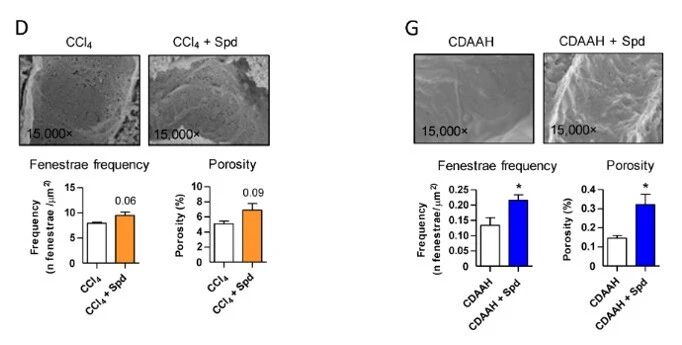
Spermidine treatment can improve hepatocyte viability and the integrity of hepatic endothelial tissue in mice under fibrosis-promoting conditions.
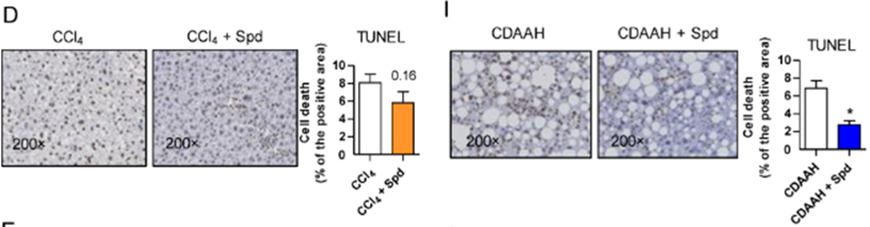
Spermidine can reduce the accumulation of hepatocyte death.
To further investigate tissue fibrosis, Hernández and his colleagues directly examined scar tissue in a mouse model of liver disease. They found that, although spermidine did not reduce the accumulation of scar tissue, it decreased the buildup of dying cells by approximately 38% in a toxic‑induced liver injury model and by about 71% in a fatty liver model. These findings suggest that, while spermidine does not markedly diminish tissue scarring, it significantly attenuates cell death under conditions that promote fibrosis.
Spermidine can promote mitochondrial biogenesis in fibrotic livers.
Hernández and his colleagues subsequently stained mouse endothelial cells with antibodies. , This study investigated how oxidative stress conditions (H₂O₂) that promote fibrosis affect mitochondria, the cellular organelles responsible for energy production. The research team found that H₂O₂ significantly reduces mitochondrial DNA levels, indicating a decline in mitochondrial abundance. Supplementing these cells with spermidine markedly increased mitochondrial DNA content. Under conditions that exacerbate fatty liver disease, spermidine likewise led to a significant elevation in mitochondrial DNA concentration. These findings suggest that spermidine sustains the energy‑producing capacity of endothelial cells by increasing mitochondrial numbers.
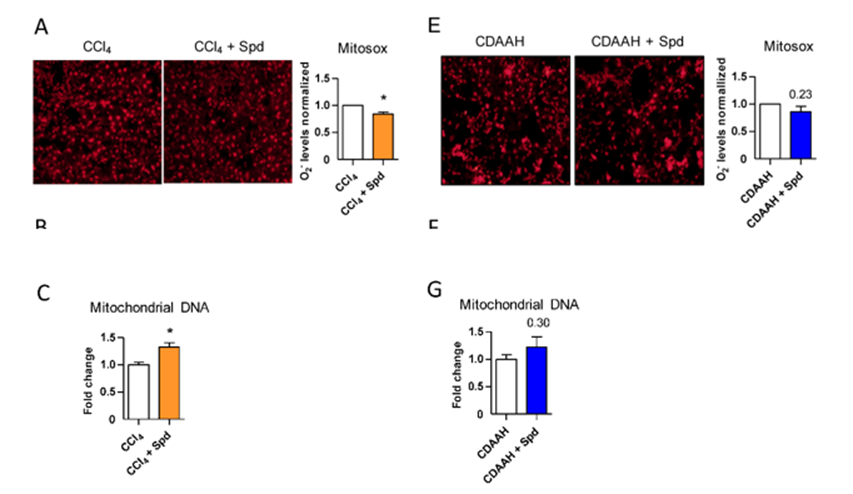
Spermidine treatment reduces the accumulation of oxidative stress–associated superoxide species and alleviates mitochondrial stress, as evidenced by an increase in mitochondrial density.
Exploring the detailed mechanisms underlying the action of spermidine
Researchers at the University of Barcelona have, for the first time, demonstrated that spermidine not only prevents the degeneration of liver tissue under toxic conditions but also maintains endothelial cell health by restoring mitochondrial numbers. Furthermore, spermidine alleviates oxidative stress by reducing the accumulation of reactive oxygen species, particularly superoxide.
The precise mechanisms by which spermidine slows the progression of liver fibrosis in mice remain unclear. However, this study corroborates earlier findings that spermidine can reduce the accumulation of reactive oxygen species in endothelial cells. A key question for future research is whether spermidine exerts similar effects in humans. Moreover, once scientists elucidate the more detailed molecular mechanisms underlying spermidine’s actions, we will be able to harness this knowledge to develop novel therapeutic agents for more targeted treatment of liver diseases.
References
Campreciós G, Ruart M, Anton A, Suárez-Herrera N, Montironi C, Martínez C, Jiménez N, Lafoz E, García-Calderó H, Vilaseca M, Magaz M, Coll M, Graupera I, Friedman SL, García-Pagán JC, Hernández-Gea V. Spermidine Supplementation Protects the Liver Endothelium from Liver Damage in Mice. Nutrients. 2021 Oct 21;13(11):3700. doi: 10.3390/nu13113700. PMID: 34835956; PMCID: PMC8617984.
Leave a Message Online


Hotline: 021-68187180

Fax: 021-68187179

Email: services@syncozymes.com
Email:sales@syncozymes.com

Address: No. 1199, Landian Road, Zhoupu Town, Pudong New Area, Shanghai

 Shanghai Public Security Bureau Internet Information Service Security Filing No. 31011502015262
-
-