
Tofacitinib Citrate: Progress in the Development of the API Synthesis Process
Classification: Industry News
Publication:2026-05-21 10:08
I. Overview
Tofacitinib citrate is the world’s first approved oral JAK inhibitor, developed by Pfizer.
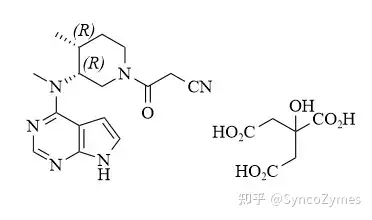
1.1 Marketing Information for Tofacitinib Citrate
1993: Pfizer scientists first identified the pivotal role of JAK kinases in immune signaling pathways, establishing them as a central therapeutic target for autoimmune diseases.
1996: Pfizer, using high-throughput screening, identified a lead compound with JAK kinase inhibitory activity from among hundreds of thousands of compounds, officially launching drug development.
1997: Pfizer collaborated with the U.S. National Institutes of Health, focusing on the selective inhibition of JAK3 and advancing compound structure optimization.
1999: Pfizer screened and identified CP-690550 (tofacitinib), which exhibits crystalline stability, excellent oral bioavailability, and potent JAK inhibition, and was designated as a lead compound.
2001–2012: Tofacitinib completed clinical trials, confirming its significant efficacy and safety in the treatment of rheumatoid arthritis.
November 2012: Tofacitinib citrate was approved by the FDA for the treatment of rheumatoid arthritis, becoming the world’s first oral JAK inhibitor; subsequently, it received approval for additional indications, including psoriatic arthritis, ankylosing spondylitis, ulcerative colitis, and polyarticular juvenile idiopathic arthritis. In February 2016, an extended-release tablet (XR) was launched, enhancing patient convenience.
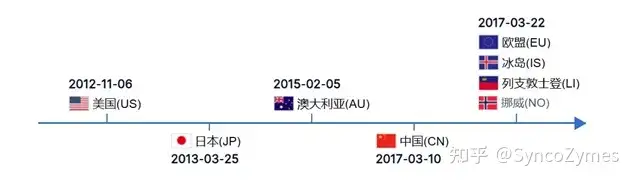
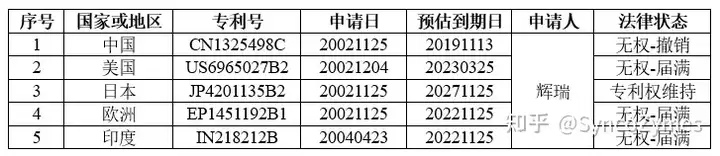
1.2 Patent Status of Tofacitinib Citrate Compounds and Polymorphs in Major Countries and Regions
Table 1: Patent Status of Tofacitinib Citrate Compounds in Major Countries and Regions
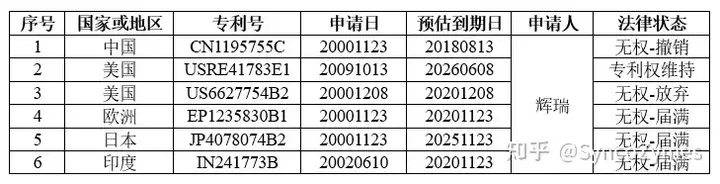
Table 2: Patent Status of Tofacitinib Citrate Polymorphs in Major Countries and Regions
II. Retrosynthetic Analysis of the Tofacitinib Citrate API Molecule
According to retrosynthetic analysis, tofacitinib citrate (compound 1) comprises three key fragments—A, B, and C. Both of its chiral centers are located in fragment A, and the synthetic route based on fragment C is relatively straightforward. The following section will focus on the synthetic route for fragment A, with a brief summary of the synthesis of fragment B.
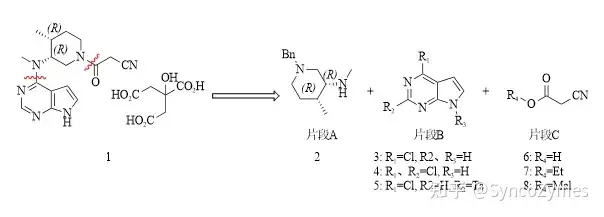
III. Synthetic Route for Key Fragment A of Tofacitinib Citrate
① Chemical method
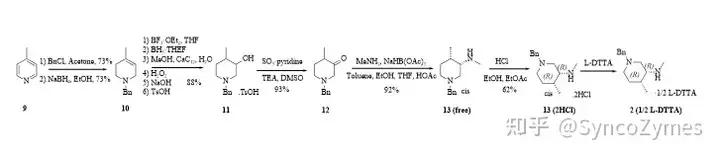
Route 1 (referencing the original research company’s CN1729192A, Org. Process Res. Dev , 2003, 7 , 115–120): Using 4-methylpyridine as the starting material, intermediate 2 was obtained through a six-step sequence involving benzyl protection and pyridine ring reduction, hydroboration–oxidation, oxidation, reductive amination, salt formation, and resolution.
Route Two (referencing the original research company) Org. Process Res. Dev , 2005, 9 , 51–56): Using 3-amino-4-methylpyridine as the starting material, intermediate 2 was obtained through a four-step sequence involving acylation, hydrogenation, methylation, and salt formation followed by resolution.
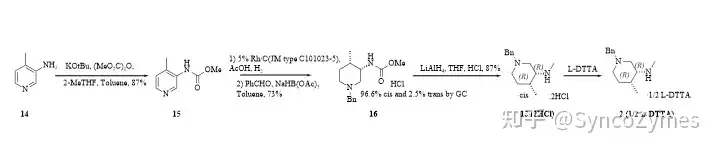
P.S.: This is merely a brief overview of the original manufacturer’s chemical synthesis route; other chemical routes will not be discussed further.
②Chemical–Enzymatic Method
Route 3: Starting from 1-benzyl-4-methylpiperidine-3-one, the intermediate 2 is obtained via catalysis by an imine reductase.
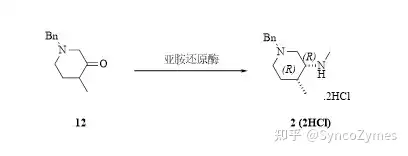
Shangke Biotechnology has also developed a method for preparing intermediate 2 via imine reductase catalysis, achieving a substrate concentration of up to 100 g/L, a conversion rate exceeding 95%, and an enantiomeric excess (ee) of 99.9%.
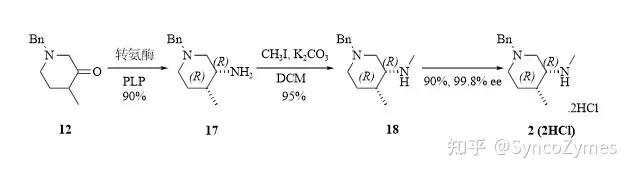
Route 4: Starting from 1-benzyl-4-methylpiperidine-3-one, an intermediate 2 is obtained through a three-step sequence involving transaminase catalysis, methylation, and salt formation.
IV. Synthetic Route for Tofacitinib Citrate Fragment B
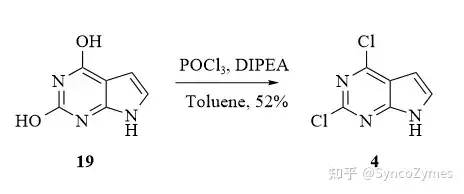
Route: Starting from 2,4-dihydroxypyrido[2,3-d]pyrimidine, the intermediate 4 is obtained via a chlorination reaction.
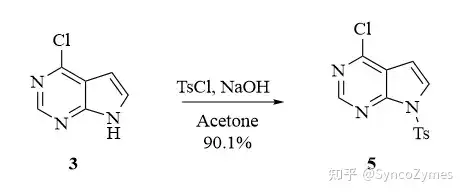
Route: Starting from 4-chloropyrrolopyrimidine, the intermediate 5 is obtained via Ts protection.
V. Synthesis of Tofacitinib Citrate
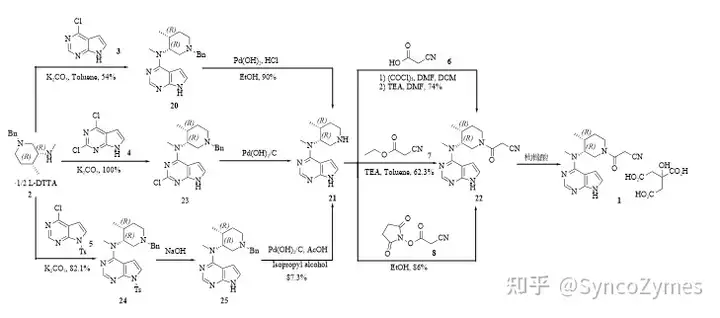
Route (patents owned by the original research company: CN1325498C, CN101233138A): Intermediate 2 and intermediate 3 (or 4, 5) are converted into tofacitinib citrate through a four‑step (or five‑step) reaction sequence.
VI. Marketing Information for Generic Tofacitinib Citrate
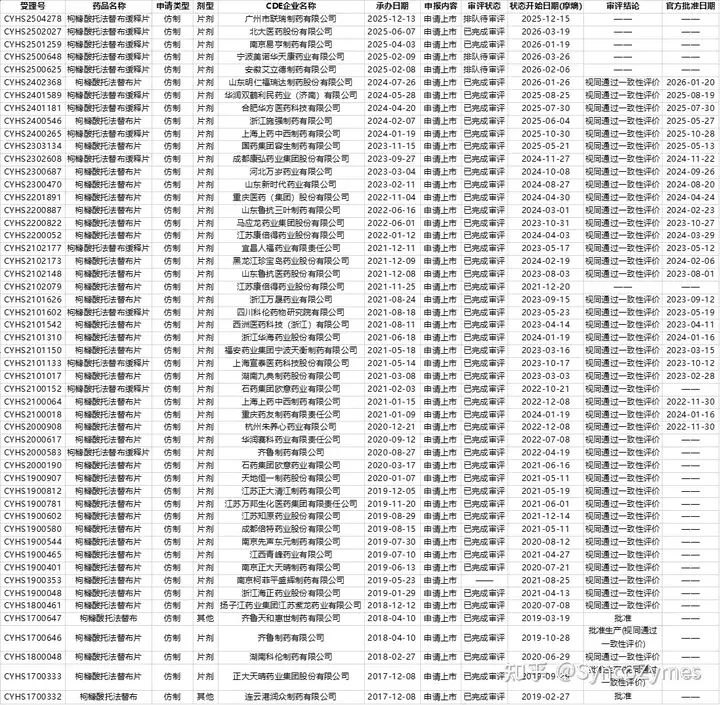
Since 2019, several domestic companies, including CP Tianqing, CR Double Crane, Qilu Pharmaceutical, and Kelun Pharmaceutical, have successively received marketing approval for generic tofacitinib citrate. Specific details are provided in the table below.
Table 3: Market Launch Information for Generic Tofacitinib Citrate (Source: Mozheng Pharmaceutical)
References
[1] Pfizer. Optical resolution of (1-benzyl-4-methylpiperidin-3-yl)methylamine and its use in preparing pyrrolo[2,3-d]pyrimidine derivatives as protein kinase inhibitors: China 1729192A [P]. 2006-02-01.
[2] David H. Brown Ripin, Stefan Abele, Weiling Cai, et al. Development of a Scaleable Route for the Production of cis-N-Benzyl-3-methylamino-4-methylpiperidine[J]. Org. Process Res. Dev , 2003, 7 , 115-120.
[3] Weiling Cai, James L. Colony, Heather Frost, et al. Investigation of Practical Routes for the Kilogram-Scale Production of cis-3-Methylamino-4-methylpiperidines[J]. Org. Process Res. Dev , 2005, 9 , 51-56.
[4] East China University of Science and Technology. Imine reductase mutant and its application in the preparation of chiral amine building blocks for tofacitinib: China 118909992A [P]. 2024-11-08.
[5] Zhejiang Lepu Pharmaceutical Co., Ltd. A method for the enzymatic synthesis of a chiral tofacitinib citrate intermediate: China 113930404B [P]. 2023-10-13.
[6] Pfizer. Pyrrolo[2,3-d]pyrimidine derivatives, their intermediates, and synthesis methods: China 101233138A [P]. 2008-07-30.
[7] Pfizer. Novel crystalline compound: China 1325498C [P]. 2007-07-11.
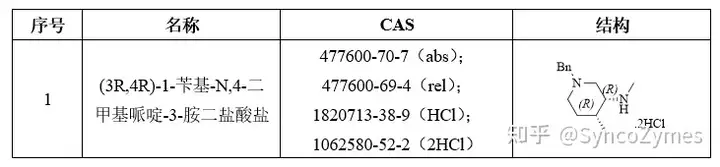
Attachment: Tofacitinib Citrate Intermediate provided by SyncoZymes (Shanghai) Co., Ltd.
Leave a Message Online


Hotline: 021-68187180

Fax: 021-68187179

Email: services@syncozymes.com
Email:sales@syncozymes.com

Address: No. 1199, Landian Road, Zhoupu Town, Pudong New Area, Shanghai

 Shanghai Public Security Bureau Internet Information Service Security Filing No. 31011502015262
-
-