
Biocatalysis Series — Formate Dehydrogenase
Classification: Industry News
Publication:2026-06-11 16:42
Introduction to Formate Dehydrogenase
Formate dehydrogenase (FDH) is a class of enzymes that catalyze the oxidation of formate to carbon dioxide while reducing the coenzyme NAD(P). + The reaction that regenerates NAD(P)H is an important enzyme in the coenzyme regeneration system of redox biosynthesis. It can also catalyze the oxidation of formate to CO₂. 2 of the reversible reaction, primarily applied to CO 2 Fixation technique [1] . The reaction is shown in Figure 1.
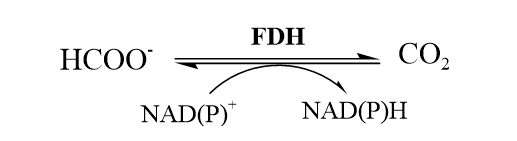
Figure 1. Reaction equation of formate dehydrogenase
Formate dehydrogenase is widely distributed in bacteria, archaea, yeast, fungi, plants, and vertebrates. [2] FDHs can be classified into metal-ion-dependent FDHs and NAD(P)-dependent FDHs, depending on the cofactors they rely on. + Dependent FDH. Metal-ion–dependent active sites contain metal elements such as tungsten, iron, and molybdenum; NAD(P) + Dependency-type FDHs do not contain metal ions and constitute the most prominent class of FDHs currently. [3] 。
The structure of FDH is a dimer composed of two identical subunits, each containing a coenzyme-binding domain and a substrate-binding domain; each domain consists of alternating α-helices and β-sheets. NAD + The coenzyme-binding domain of the dependent FDH contains a conserved GxGxxGx motif. 17-18 D(E) sequence (where x represents any residue), belonging to the Rossmann fold (as shown in Figure 2). [3] [4] 。
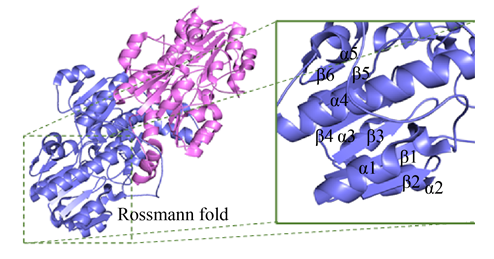
Figure 2. NAD + Dependent FDH Structure [3]
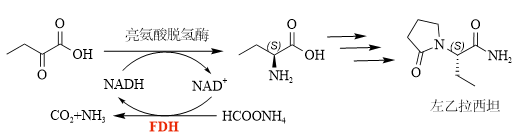
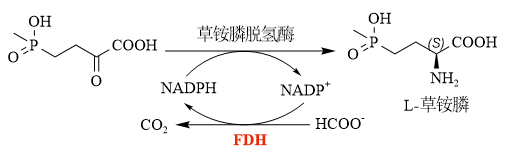
Formate dehydrogenase has the advantages of wide availability and produces only CO as a byproduct in its catalytic reaction. 2 , CO 2 It is readily removed from the reaction system and does not inhibit enzyme activity. Furthermore, its optimal pH range is relatively broad, thereby expanding its operational window, and its reaction conditions are well suited for industrial-scale production. [3] Formate dehydrogenase primarily serves as a “regenerating agent” in cofactor regeneration systems. Such systems are essential for the biocatalytic processes of redox enzymes and are widely employed in the production of various chiral compounds, including chiral amino acids, chiral carboxylic acids, chiral alcohols, and chiral amines. Examples of applications are as follows:
Example 1 , Preparation of an intermediate for the antiepileptic drug levetiracetam [5]
Example 2 , Preparation of herbicides L- Glufosinate [6]
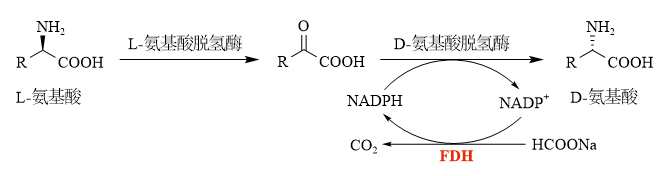
Example 3、L- One-pot preparation via amino acid–mediated biocatalytic cascade reactions D- Amino acid [7]
Catalytic Mechanism of Formate Dehydrogenase Reaction
Currently, NAD + The catalytic mechanism of the formate dehydrogenase (FDH) is relatively well understood. When formate enters the active site of FDH, the side chain of arginine (Arg) at position 284 interacts with the negatively charged carboxyl group (COOH). – They interact to form salt bridges and establish hydrogen bonds with the side chain of asparagine (Asn) at position 146. The proton from the formate ion is transferred to NAD. + at the C4 atom of the nicotinamide ring, while NAD + Accepts hydrogen to form NADH and releases CO. 2 . After NADH is released, the enzyme returns to its open conformation, binds the next molecule of NAD⁺, and prepares to enter a new cycle. (As shown in Figure 3.) [3] [8] 。
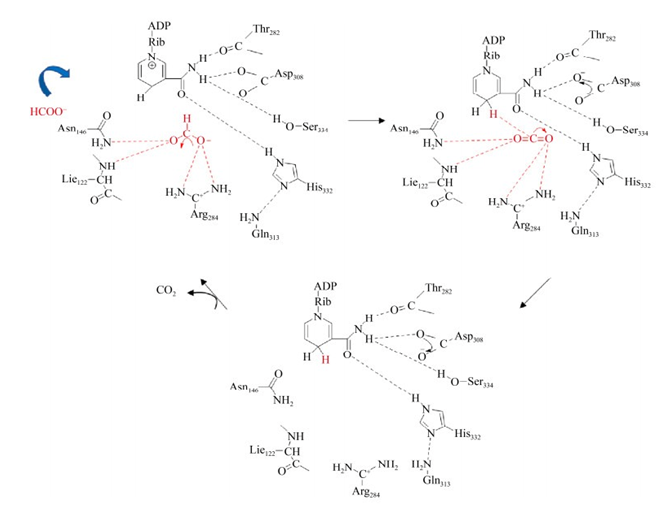
Figure 3. NAD + Catalytic Mechanism of the Dependent FDH [3]
Formate Dehydrogenase Enzyme Library and Enzyme Development Services
Since 2007, Shangke Bio has been dedicated to the research and development of bioenzymes, biocatalytic technologies, and synthetic biology techniques. Its existing formate dehydrogenase enzyme library (code-named ES-FDH) comprises five distinct formate dehydrogenases from various sources, enabling the company to offer customers enzyme screening, optimization of enzymatic reaction processes, enzyme engineering, and production‑supply services.
References
[1] Lu Feng, Huang Yuhong, Lin Yanna, et al. Research progress on the molecular engineering of formate dehydrogenase for CO2 reduction [J]. Biotechnology Bulletin, 2025, 41(3): 14–24.
[2] Saadet Alpdagtasa and Barıs¸ Binayb. NADP+ Dependent Formate Dehydrogenase: A Review [J]. Biocatalysis and Biotransformation, 2021, 39(4):260-268.
[3] Cheng Feng, Wei Lan, Wang Chengjiao, et al. Formate dehydrogenase and its applications in chiral biomanufacturing [J]. Chinese Journal of Biotechnology, 2022, 38(2): 632–649.
[4] Maier A, Mguni L M, Ngo A C R, et al. Formate Dehydrogenase: Recent Developments for NADH and NADPH Recycling in Biocatalysis [J]. ChemCatChem, 2024, 16(21).
[5] Zhang Beining. Enhancement of the Thermal Stability of Formate Dehydrogenase through Semi-Rational Engineering and Its Applications [D]. Jiangnan University, 2025.
[6] Cao CH, Gong H, Dong Y, et al. Enzyme cascade for biocatalytic deracemization of D, L-phosphinothricin [J]. Biotechnol, 2021, 325: 372-379.
[7] Zhang DP, Jing XR, Zhang WL, et al. Highly selective synthesis of D-amino acids from readily available L-amino acids by a one-pot biocatalytic stereoinversion cascade [J]. RSC Advances, 2019, 9:29927-29935.
[8] Jiafu Shi, Yanjun Jiang, Zhongyi Jiang, Xueyan Wang, Xiaoli Wang, Shaohua Zhang, Pingping Hana, and Chen Yang. Enzymatic conversion of carbon dioxide [J]. Chem. Soc. Rev., 2015, 44, 5981-6000.
Leave a Message Online


Hotline: 021-68187180

Fax: 021-68187179

Email: services@syncozymes.com
Email:sales@syncozymes.com

Address: No. 1199, Landian Road, Zhoupu Town, Pudong New Area, Shanghai

 Shanghai Public Security Bureau Internet Information Service Security Filing No. 31011502015262
-
-