
New European research: NMN can enhance the antiviral activity of CD8 T cells, a type of virus-specific immune cell, in patients with hepatitis B.
Classification: Industry News
Publication:2023-05-19 13:41
For patients with chronic hepatitis B, the high-level exposure of hepatitis B virus–specific immune cells (CD8 T cells) to the virus and other pathogens leads to DNA damage and functional impairment in these CD8 T cells. Elucidating the cellular mechanisms underlying CD8 T‑cell dysfunction could facilitate the development of therapeutic strategies for chronic hepatitis B. Recent studies have shown that NAD+ depletion underlies CD8 T‑cell exhaustion.
Recently, a team led by Professor Fisicar from the University of Parma in Italy published an article titled “Deregulated intracellular pathways define novel molecular targets for HBV-specific CD8 T cell reconstitution in chronic hepatitis B” in the journal Hepatology.
This article provides evidence for the therapeutic effects of NMN in treating hepatitis B and demonstrates that NMN can be used to restore the function of impaired CD8 T cells, thereby combating chronic hepatitis B virus infection.
Researchers first isolated immune cells from patients with chronic hepatitis B for analysis. After treating these immune cells with NMN, they observed increased expression of antiviral cytokines, with the cytokine interferon‑γ (IFN‑γ) rising by 2.7‑fold. These findings indicate that NMN restores the antiviral functions of CD8 T cells.
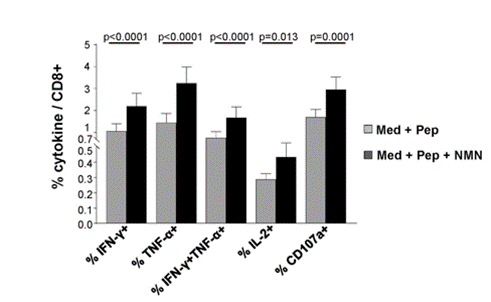
Figure | NMN restores the production of antiviral cytokines by immune cells.
To demonstrate that chronic hepatitis B infection is associated with CD8 T-cell dysfunction, the researchers compared DNA damage in hepatitis B–specific CD8 T cells with that in influenza (FLU)–specific T cells. They observed significantly greater DNA damage in hepatitis B–specific CD8 T cells. Furthermore, they found that treatment with a DNA‑damaging agent (etoposide) induced a trend toward reduced DNA‑damage responses in these cells relative to FLU‑specific T cells. Given that PARP‑mediated DNA‑damage responses depend on NAD+, these findings suggest that NAD+ deficiency correlates with elevated levels of DNA damage in hepatitis B–specific CD8 T cells undergoing exhaustion.
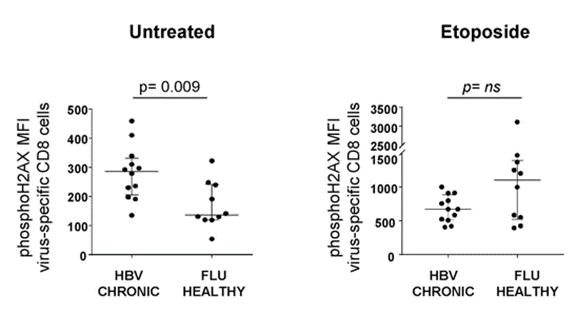
Figure | Hepatitis B CD8 T cells exhibit high levels of DNA damage.
To further investigate how NMN-mediated NAD+ supplementation improves the production of antiviral cytokines by impaired CD8 T cells, the researchers examined the relationship between elevated levels of the NAD+-depleting enzyme CD38 and cytokine expression. They measured a key cytokine—IFN‑γ—and found that high CD38 activity was associated with low IFN‑γ levels. These findings provide evidence that elevated CD38 activity can lead to reduced production of antiviral cytokines. This also lends credibility to the hypothesis that low NAD+ levels play a critical role in the pathogenesis of chronic hepatitis B, as high CD38 activity is expected to deplete cellular NAD+.
The experimental results demonstrate that nicotinamide mononucleotide (NMN) can effectively enhance the antiviral activity of CD8 T cells—specific immune cells—in patients with chronic hepatitis B, thereby improving their antiviral capacity. This offers a promising strategy for further research and exploration of immunotherapy.
Source of the literature:
Montali I, Berti CC, Morselli M, Acerbi G, Barili V, Pedrazzi G, Montanini B, Boni C, Alfieri A, Pesci M, Loglio A, Degasperi E, Borghi M, Perbellini R, Penna A, Laccabue D, Rossi M, Vecchi A, Tiezzi C, Reverberi V, Boarini C, Abbati G, Massari M, Lampertico P, Missale G, Ferrari C, Fisicaro P. Deregulated intracellular pathways define novel molecular targets for HBV-specific CD8 T cell reconstitution in chronic hepatitis B. J Hepatol. 2023 Mar 7:S0168-8278(23)00167-8. doi: 10.1016/j.jhep.2023.02.035. Epub ahead of print. PMID: 36893853.
Leave a Message Online


Hotline: 021-68187180

Fax: 021-68187179

Email: services@syncozymes.com
Email:sales@syncozymes.com

Address: No. 1199, Landian Road, Zhoupu Town, Pudong New Area, Shanghai

 Shanghai Public Security Bureau Internet Information Service Security Filing No. 31011502015262
-
-