
Introduction to the Biocatalytic Enzyme Series: Nitrile Hydratase
Classification: Industry News
Publication:2025-02-28 09:17
I. Introduction to Nitrile Hydratase
Nitrile hydratase (NHase) is a class of metalloenzymes that catalyze the hydrolysis of nitrile compounds, cleaving the carbon–nitrogen triple bond to yield the corresponding amide derivatives.

Nitrile hydratases typically consist of two subunits, α and β, and their gene clusters often harbor a metal‑ion‑binding activator protein that facilitates the maturation of the enzyme. Based on the distinct metal ions coordinated in the active site, nitrile hydratases are classified into cobalt‑type nitrile hydratases (Co‑NHases) and iron‑type nitrile hydratases (Fe‑NHases), which respectively bind trivalent low‑spin non‑corrole cobalt and trivalent low‑spin non‑porphyrin iron [1–4].
Whether it is Co‑NHase or Fe‑NHase, nitrile hydratases all contain a highly conserved amino acid sequence (Cys‑X‑X‑Cys‑Ser‑Cys) that forms a “claw‑like” structure and specifically binds metal ions, thereby constituting the active site. The key difference between Co‑NHase and Fe‑NHase is that, in Co‑NHase, a water molecule occupies the position directly above the claw‑like motif, whereas in Fe‑NHase, this position is occupied by a nitric oxide molecule [5].
Example 1: Synthesis of amides [6]

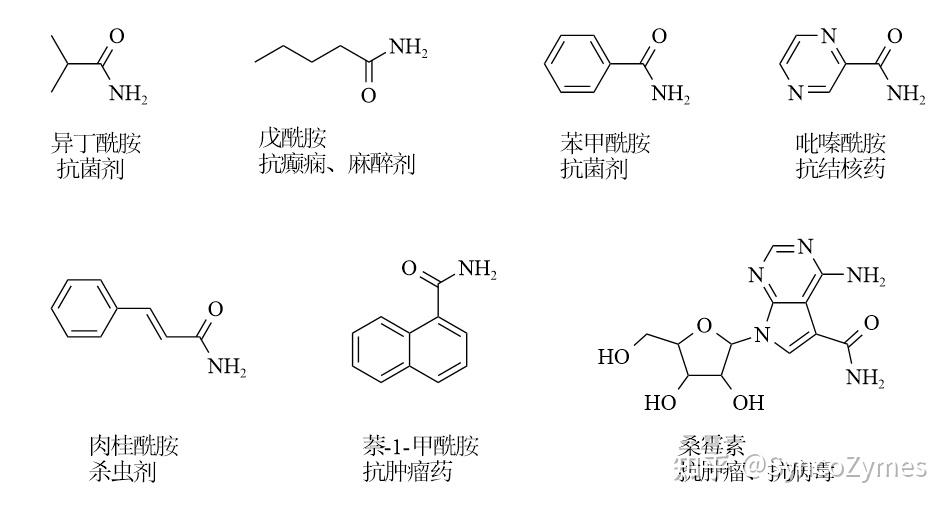
Amide compounds exhibit significant application value across industries such as manufacturing, agriculture, and pharmaceuticals. Small‑size amides like acrylamide and nicotinamide serve as bulk chemicals, whereas bulky amides typically function as precursors to high‑value pharmaceuticals and as pharmaceutical intermediates (see Figure 1).
Example 2: Coupling with amidase to generate isohydroxamic acid [7]
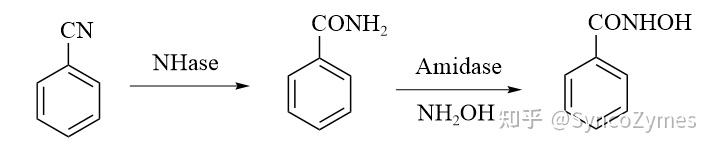
In the pharmaceutical field, hydroxamic acid compounds can be used to treat diseases such as cancer, arthritis, asthma, and tissue necrosis [8].
As a green biocatalyst, NHase offers numerous advantages in the synthesis of amide compounds: (1) the reaction generates no by‑products; (2) it is a one‑step enzymatic process with a straightforward procedure; and (3) the reaction conditions are mild.
II. Catalytic Mechanism of Nitrile Hydratase [9]
At present, there are four widely accepted catalytic mechanisms for nitrile hydratase (mechanisms 1–4); with the exception of mechanism 4, which is based on P. thermophila The crystal structure data of the JCM 3095 nitrile hydratase–substrate complex were used to infer the mechanism; the remaining mechanisms are all directly inferred with the involvement of water molecules.
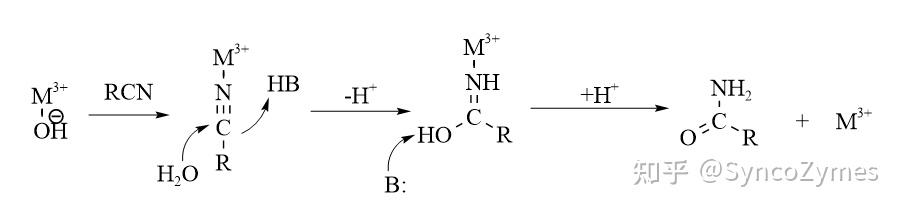
Mechanism 1: Inner-sphere mechanism
The nitrogen atom of the substrate’s cyano group forms a coordinate covalent bond with the metal ion in the enzyme’s active site, while a water molecule acts as a nucleophile and directly attacks the carbon atom of the substrate’s cyano group, thereby forming an amide bond (see Figure 2).
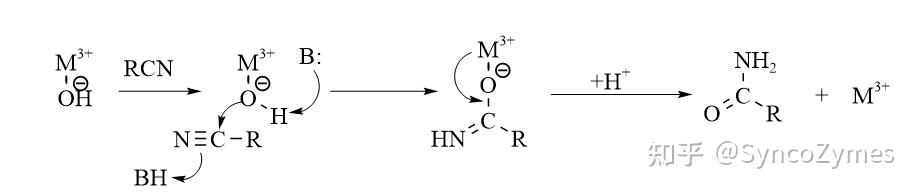
Mechanism 2: Outer Ball Mechanism
Water molecules are polarized at the active site of nitrile hydratase, leading to the dissociation of a hydroxide ion. This hydroxide ion coordinates with the metal ion and then attacks the carbon atom of the substrate’s cyano group, forming the transition-state intermediate (R‑C(–OH)=NH). Finally, after rearrangement of this transition-state intermediate, the amide product is obtained (see Figure 3).
Mechanism 3: Sub‑outer layer mechanism
Unlike the outer-sphere mechanism, after the hydroxide ion coordinates with the metal ion, it first activates a nearby water molecule, which then serves as a nucleophile to attack the substrate via its hydroxyl group. Throughout this process, the coordination sphere of the metal ion remains unchanged (see Figure 4).
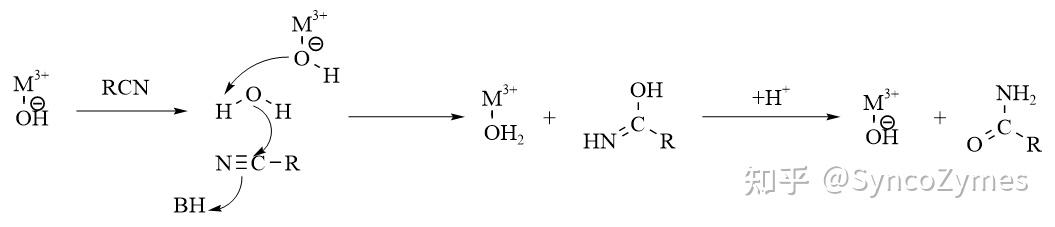
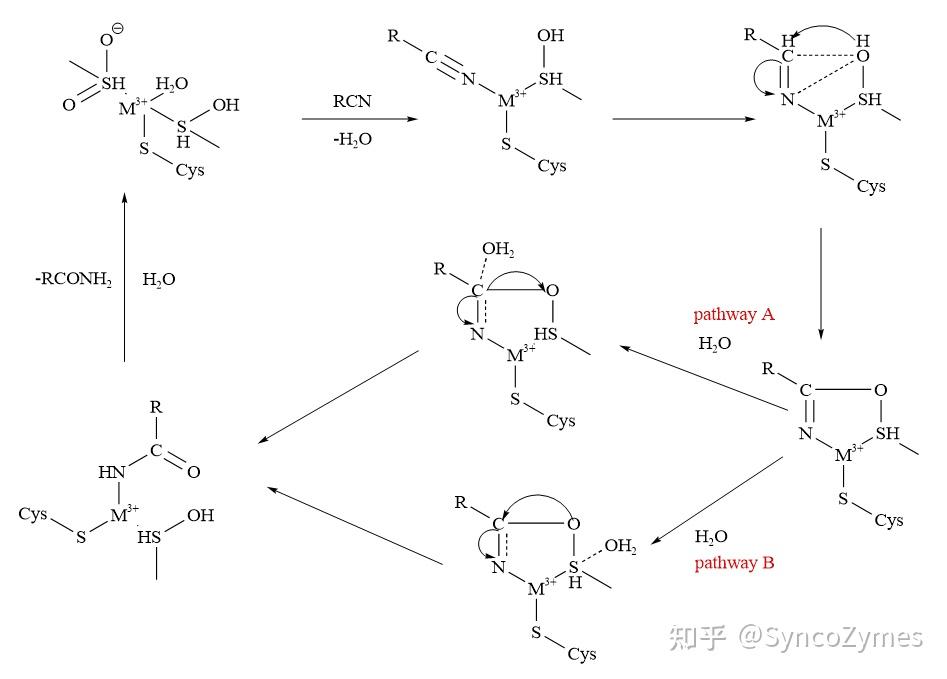
Mechanism 4: A mechanism established based on the crystal structure of the nitrile hydratase–substrate complex.
When the cysteine residue at position 113 in nitrile hydratase is oxidized to a cysteine‑sulfinic acid, it undergoes nucleophilic attack on the substrate coordinated to the metal ion, generating a transition‑state product—a (R‑C(–OH)=NH) intermediate. Once proton transfer occurs in this intermediate, the carbon atom of the transition‑state product (pathway A) or α‑Cys113 (pathway B), upon nucleophilic attack by a water molecule, ultimately isomerizes to an amide (see Figure 5).
III. Introduction to Shangke Bio’s Nitrile Hydratase Enzyme Library and Enzyme Development Services
Since 2007, Shangke Bio has been dedicated to the research and development of bioenzymes, biocatalytic technologies, and synthetic biology techniques. Its existing nitrile hydratase enzyme library (Shangke Bio’s internal code: ES‑NHT) comprises 24 distinct nitrile hydratases, enabling the company to offer customers enzyme screening, optimization of enzymatic reaction processes, enzyme engineering, and production‑supply services.
IV. References
[1] Nagashima S, Nakasako M, Dohmae N, et al. Nature Structural Biology, 1998, 5(5): 347.
[2] Miyanaga A, Fushinobu S, Ito K, et al. European Journal of Biochemistry, 2004, 271(2): 429-438.
[3] Arakawa T, Kawano Y, Kataoka S, et al. Journal of Molecular Biology, 2007, 366(5): 1497-1509.
[4] Brodkin H R, Novak W R, Milne A C, et al. Biochemistry, 2011, 50(22): 4923-4935.
[5] Song L, Wang M, Shi J, et al. Biochemical and Biophysical Research Communications, 2007, 362(2): 319-324.
[6] Guo Junling, Mining and Semi-Rational Engineering of High-Performance Nitrile Hydratase. [D] Wuxi: Jiangnan University, 2023.
[7] Vojtech V., Ludmila M., Alicja B. V., et al. J Mol Catal B—Enzyme, 2011, 71: 51–55.
[8] Zeng Wenbin, Design, Synthesis, Structural Analysis, and Antitumor Activity Study of Hydroxamic Acid Derivatives. [D] Jiangxi: Nanchang University, 2013.
[9] Ma Dong, Substrate Spectrum and Catalytic Performance of Nitrile Hydratase Engineered via Semi-Rational Design. [D] Wuxi: Jiangnan University, 2024.
Leave a Message Online


Hotline: 021-68187180

Fax: 021-68187179

Email: services@syncozymes.com
Email:sales@syncozymes.com

Address: No. 1199, Landian Road, Zhoupu Town, Pudong New Area, Shanghai

 Shanghai Public Security Bureau Internet Information Service Security Filing No. 31011502015262
-
-